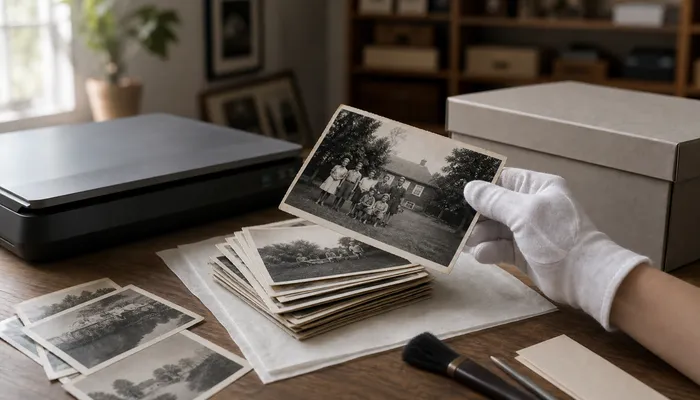
Family photographs rarely stay in perfect condition. They fade on a living-room wall, crease in a shoebox, or get passed around every time relatives visit. Across Illinois, and especially in the older communities just west of Chicago, more households are sorting through those pictures and asking one practical question: can this one be saved? That question is why restoring old photos has become one of the most common projects families bring to a professional studio, and why it now fills a steady part of the schedule at Video Studio Jimenez, a Chicago photography studio that works with families throughout the Near West Suburbs.
Illinois is a Midwestern state whose largest city is Chicago, and the Near West Suburbs sit inside that metropolitan area — Berwyn, Cicero, Franklin Park, Maywood, Melrose Park and Oak Park are all part of the same compact stretch of Cook County (Illinois). That matters for this kind of work. Many households in the region keep photographs that arrived in the United States in a suitcase or an envelope, or that have hung in the same hallway for decades. When those pictures begin to fail, families usually notice all at once.
What Restoring Old Photos Actually Involves
Restoration is not a filter and it is not a single click. A professional workflow usually moves through three stages: careful handling of the original, a high-resolution scan that captures as much detail as the print or negative still holds, and then digital repair — reconnecting torn edges, reducing scratches and stains, rebuilding faded contrast, and cleaning up marks left by tape, water or mold. The goal is a faithful image, not a brand-new one. A restored portrait should still look like the person in the frame, and like the era it came from.
The studio team has handled wedding albums, quinceañera portraits, military portraits, first-communion photos and simple snapshot prints across more than 15 years of portrait and event work. The approach is built around preservation first: originals are scanned before any retouching begins, so the family keeps a digital master even if the paper copy continues to age.
Which Photographs Families Bring In First
In practice, a few categories dominate. Wedding photographs come in most often, followed closely by quinceañera portraits and images of parents or grandparents when they were young. Portraits from the 1940s through the 1980s tend to arrive with the same set of problems: silvering in the dark areas, yellowing from light exposure, curled corners, and creases along the middle where the print was folded to fit a wallet or a frame.
Families planning a celebration often bring a second box at the same time — the pictures they want displayed at a reception or given as gifts. Parents and couples who are looking for coverage of a new event can review what is available through wedding and quinceañera photographers in Cicero, IL, and many of them end up pairing an event booking with restoration of an older portrait of the same family.
Damage That Responds Well — and Damage That Needs Patience
Not every problem is equal. Surface dust, light scratches, fading, color shifts, small tears and creases usually respond well to a careful digital approach. Photographs that are stuck to glass, fused to an album page, or affected by mold are a different situation, and they need to be examined before anyone starts pulling at them. Handling those originals at home is where most permanent damage happens. If a print is stuck to glass or shows visible mold, it is worth reading what not to do with photos stuck to glass or damaged by mold before the photograph is moved again.
It is also fair to say what restoration cannot do. Missing information cannot be invented. If a corner of a print is gone — a hand, part of a background, an edge of a face — a restorer can rebuild the surrounding area plausibly, but the result is an interpretation, not a recovered fact. Families are usually best served when they say up front what matters most: the face, the uniform, the date written on the back.
Scan First or Retouch First? Why the Order Matters
The order of operations is one of the least visible parts of the process and one of the most important. A scan made after a round of retouching captures the retouching, nothing more. A scan made first captures what the original actually contains, including detail that may be useful later. Once the digital master exists, work can be done in layers, saved non-destructively, and revisited if the family wants a different look. For families weighing their options, the real question is not whether restoring old photos is possible, but how much of the original detail can be preserved. The difference between a preservation scan and a quick phone photo of a print is explained further in restoring photos in digital format without quality loss.
How to Prepare Originals Before a Restoration Appointment
Preparation is simple and mostly about restraint. Keep prints flat, dry and away from direct sun. Hold them by the edges, ideally with clean cotton gloves. Do not tape, glue, laminate or write on the front of a print, and avoid stacking heavy books on a fragile photo to flatten it. Note the names, dates and places you already know on a separate sheet of paper — that context is often the difference between a technically clean file and a meaningful family document.
If the photographs are still in an album with sticky pages, leave them where they are until they can be reviewed. Households searching for family photo restoration in Berwyn, IL often find it easier to bring the whole album to the Chicago studio and let the team assess which pages can be safely separated before anything is scanned.
When Restoration Turns Into a New Family Session
Many restoration projects end with a new photograph. A family restores a portrait of a grandmother, then decides it is also time for an updated picture of the grandchildren. That is a natural pairing: the restored print covers the past, and a new session covers the present, with consistent lighting and editing so the two can hang side by side.
Parents preparing for a new addition, for example, often book maternity and newborn photographers in Melrose Park, IL while older family prints are still being restored, so the new images are ready around the same time. Families who would rather start with something simple before committing to a larger project can look at photo studio sessions in Franklin Park, IL, which cover clean, well-lit portraits without the planning a full event requires.
Documents, Records and Everyday Practicalities
Restoration often sits beside more routine photography needs. The same household that brings in a damaged portrait may also need updated identification photos, and studio-made images are produced to match the framing, background and expression rules that official documents require. Households handling applications, renewals or family paperwork can check availability for passport photos in Maywood, IL and schedule a short appointment at the studio instead of relying on a self-service kiosk.
Workplace portraits follow a similar logic. Adults who are updating a professional profile or preparing a résumé often need a clean, current image, and that can be handled in the same studio visit as a restoration review. People who work downtown or remotely can ask about professional headshots in Oak Park, IL and combine a portrait session with a drop-off of older prints.
How the Studio Handles Restoration Across the Region
Video Studio Jimenez works out of its Chicago studio at 4926 W. Diversey Ave. and serves families from the surrounding suburbs. Restoration is handled as studio work: originals are scanned and protected on site, retouching happens digitally, and the family decides whether they want a repaired digital file, a reprinted print, or both. Appointments are available Monday through Saturday, 9:00 AM to 7:00 PM, and the studio can be reached at (847) 420-3717 to discuss what a specific photograph needs.
Every project starts with a conversation about the photograph rather than a list of packages. Families are usually asked what the image is for — a frame, an album, a gift, a family history folder — because that answer changes how much work makes sense. It also helps to know the intended print size, since a file prepared for a small keepsake does not need the same resolution as a large enlargement. The studio’s Captured for Life Guarantee™ applies to its photography work, including restoration projects.
Common Questions About Restoring Old Photos
How long does a restoration project usually take?
Turnaround depends on the condition of the original and the amount of repair involved. A single print with light fading moves faster than an album page with tears, tape and water damage. The studio gives a realistic estimate after seeing the photograph rather than promising a fixed date in advance.
Can a photograph be restored if part of it is missing?
Often, yes — but the rebuilt areas are an interpretation and may not match the original exactly. Explaining which parts of the image matter most helps the restorer decide where to concentrate the work.
Do I need to bring the original print, or is a phone photo enough?
An original is almost always better. A photograph taken with a phone loses detail, adds glare and flattens the tonal range. When an original cannot travel safely, ask for guidance before moving it.
Can the original be damaged during restoration?
The repair work itself is digital. The original is handled only to scan it and is returned in the condition it arrived in. Fragile items — prints stuck to glass, mold-affected photos, brittle album pages — are assessed before any handling begins.
Is restoration available outside the suburbs named here?
Yes. The studio serves families across the Near West Suburbs and the wider Chicago area, including households that travel in from other parts of Cook County. You can bring several photographs to one appointment; reviewing them together is usually the fastest way to decide what to restore first.
If there is a box of family photographs waiting in a closet, the most useful first step is simply to look at what is inside and set aside the pieces that matter most. From there, restoring old photos can be planned in stages — scan first, repair next, reprint last — and you are welcome to contact the studio to talk through what a particular photograph needs before you commit to anything.