
Passport Photos for Infants Who Cannot Sit Still: What Parents Should Expect at the Studio
Passport Photos for Infants Who Cannot Sit Still: What Parents Should Expect at the Studio can sound like a challenge before you have even packed the diaper bag. Babies move, turn toward familiar voices, fuss when they are tired, and sometimes fall asleep just as you arrive. That is normal. A passport photo session is not a test of your baby’s ability to pose; it is a short, practical process that gives the photographer opportunities to capture an image that follows the rules for the document you are applying for.
The most useful preparation is not teaching an infant to sit still. Instead, it is knowing what the studio will do, checking the requirements for the specific passport or travel document, and planning around your child’s needs. Requirements can differ by country, application type, and age, so a photographer’s experience does not replace official instructions. This guide explains the visit step by step, offers realistic ways to make it easier, and helps you decide what to ask before you go. Families in Chicago, Illinois, may also find it helpful to think about travel time, weather, and a baby’s usual nap routine when choosing when to schedule.
Why an infant passport photo feels different from a regular portrait
The goal is a usable official image, not a posed portrait
A family portrait can include cuddling, a favorite toy, a smile, or a creative background. An official passport photograph has a narrower job: it must show the applicant clearly and meet the rules set by the relevant authority. That difference matters when photographing a baby. A photographer may take several frames to find one in which the child’s face is visible, the head is positioned appropriately, and the background and lighting are acceptable.
The session is therefore more like a calm series of brief attempts than a conventional portrait sitting. The photographer may pause, let the baby settle, adjust the camera, and try again. A few moments of movement do not mean the session has failed. The practical question is whether an image can be selected that satisfies the current requirements for that application.
Babies change expression and position quickly
Infants may lift their chin, turn toward a parent, blink, stretch, or startle at a new sound. They may also have limited head control, particularly in the early months. These behaviors are expected. Parents should not feel that they need to keep the baby motionless throughout the appointment or apologize for ordinary baby movement.
Rather than trying to control every movement, the photographer can watch for short windows when the baby is calm and facing the camera. Parents can help by staying close, speaking gently, and following the studio’s instructions. If the baby needs a pause, a brief break may be more useful than repeatedly trying to photograph during a cry.
Official requirements are not identical everywhere
Do not assume that a photograph accepted for one country, visa, or travel document will meet another authority’s specifications. Image dimensions, background, framing, facial visibility, and submission format may vary. Even rules for infants can differ. The application’s current official instructions should be your starting point, especially if the photo will be submitted digitally.
For a general overview of why specifications matter, review this guide to essential passport picture requirements. It can help you make a list of details to verify, but the issuing agency’s current instructions take priority over any general article.
What happens when you arrive at the studio
First, confirm the document and the applicable rules
Expect the photographer or staff to ask what the photo is for and which country or authority will receive it. Be specific. “Passport photo” may refer to different standards, and a passport application can have different needs from a visa or another official document. If you are unsure, bring the application instructions or have them available on your phone.
Before the camera comes out, confirm whether you need printed photographs, a digital file, or both. Ask whether the studio can prepare the format you need and whether the application requires a particular file size or dimension. A careful check at the beginning helps avoid finishing a session only to discover that the wrong type of output was requested.
The photographer prepares the scene before placing the baby
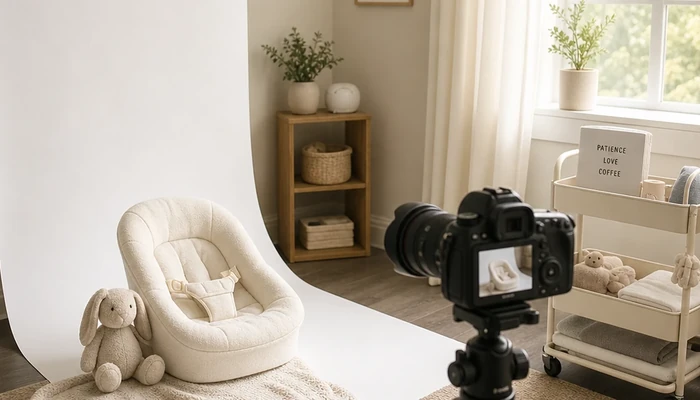
A well-organized visit usually begins with setting up the background, camera, and lighting. This matters because an infant should not be asked to wait in position while equipment is being adjusted. The photographer may check the frame and exposure first, then invite the parent to bring the baby into the prepared area when everything is ready.
Depending on the baby’s age, head control, and the authority’s rules, the photographer may use a supported position or another studio-approved method. Do not assume that every method is permitted for every application. The baby must be represented clearly, and any support, hands, or objects must not appear in the final image if the applicable rules prohibit them.
Several short attempts are more realistic than one perfect pose
There may be a few quick attempts, a pause, and another try. The photographer can review the images for framing, focus, expression, and visible obstructions. If the baby turns away or closes their eyes, the photographer can wait for a better moment rather than treating that frame as the final result.
It is reasonable to ask how image selection works and whether you will be able to review the chosen photograph. However, the studio should assess technical compliance, not just which image looks cutest. A charming grin may not be suitable if the issuing authority asks for a neutral expression, while a calm and clear image may be more appropriate.
How photographers work with babies who cannot sit still
They create a safe, supported setup
Infants should never be balanced in an unstable position for the sake of a photograph. A parent or trained assistant may need to support the child, depending on the baby’s age and the method used. The photographer should explain the setup, make sure the baby is secure, and stop if the child appears uncomfortable or the arrangement feels unsafe.
Ask in advance what support is used and whether the photographer has experience working with infants. The exact approach depends on the baby’s development and the current application rules. A good process puts safety first and does not ask a parent to improvise a risky pose.
They look for moments of alert calm
A baby does not have to smile or perform. Often, the most useful moment is a brief pause when the child is comfortable, awake, and facing forward. A familiar voice from just behind the camera can help attract attention without putting a toy or another person into the frame.
Some babies respond well to a quiet voice; others need a little time to observe the new setting. The photographer may wait for eye direction and head position to settle before taking a frame. This is one reason a rushed, single-shot approach can be stressful for both baby and parent.
They review images for compliance, not just appearance
Review should cover more than whether the baby looks adorable. The photographer should check whether the face is clear, the image is sharp, the background is suitable, and the framing matches the relevant instructions. The final selection should be assessed against the actual requirements supplied for the application.
General examples can help you recognize common issues. You can compare them with this overview of passport photo examples and common visual details. Examples are educational, not a guarantee that an image meets a particular agency’s current rules.
Before the appointment: preparation that helps without overplanning
Check the application instructions and make a simple note
Start with the official instructions for the exact application. Note whether the photo is printed or digital, any size or file requirements, and any instructions that specifically address babies. If the wording is unclear, contact the issuing authority rather than relying on a guess or an old online checklist.
It can help to bring a screenshot or printed copy. That way, you and the studio can discuss the same requirements. A secondary checklist, such as VisaFoto’s biometric photo guidance, may be useful for understanding common photo concepts, but it is not a substitute for the government’s current instructions.
Choose a time that fits your baby’s usual rhythm
Whenever scheduling allows, choose a time when your baby is commonly awake and reasonably settled. This is not a guarantee: naps and feeding patterns can change from one day to the next. Still, avoiding a time when your child is usually hungry or overtired can make the visit more comfortable.
Think about the whole trip, not only the appointment time. Consider traffic, parking, weather, and whether you will need time to feed or change the baby before the session. In Chicago, Illinois, winter clothing and changing temperatures can also affect how quickly a baby becomes comfortable after arriving indoors.
Keep clothing and the baby’s face simple
Choose comfortable clothing that does not cover the face or create distracting shapes near the chin and neck. If the application gives clothing guidance, follow it. Avoid assuming that a special outfit or accessory will improve an official photo; the priority is a clear, unobstructed view of the baby’s face.
Before leaving home, check for items that might need to be removed or adjusted, such as a blanket over the face, a large bow, or a pacifier. Do not remove medical or culturally important items without first checking the official rules and discussing options with the photographer. The right choice depends on the authority’s requirements and the child’s needs.
- Bring the application instructions or a saved copy.
- Pack diapers, wipes, a spare outfit, and feeding supplies.
- Bring a small comfort item for use before or between attempts, if appropriate.
- Allow extra time so a brief pause does not make you feel rushed.
- Confirm whether you need prints, a digital file, or a particular delivery format.
What parents can do during the photo session
Stay close and let the photographer guide the process
Your presence can help the baby feel secure. Stand or sit where the photographer directs, and use a calm voice if your child responds to it. If the photographer asks you to move out of the frame or stand behind the camera, follow that direction so you can comfort the baby without becoming part of the photograph.
Try not to give several instructions at once. A photographer may be watching the baby’s face, camera framing, and timing simultaneously. One calm voice is often more helpful than a group of adults calling the baby’s name from different directions.
Use comfort breaks when the baby needs them
If the baby starts crying, rubbing their eyes, or becoming unsettled, ask whether a short break is possible. A feed, burp, diaper change, or quiet cuddle may reset the moment. This is not wasted time; it can be the difference between a tense experience and a manageable one.
Keep comfort methods practical. A toy or pacifier may help between frames, but it may need to be removed before the photograph. Check with the photographer about when to put it away so the baby is not startled by a sudden change at the exact moment the camera is ready.
Accept that a neutral result may look less expressive
Parents often hope for a smile, especially when the baby is cheerful at home. Official-document standards may call for a particular expression or facial position, so a photograph that looks less like a family portrait can still be the better candidate. Follow the rules provided by the issuing authority rather than choosing solely by warmth or personality.
Keep your expectations flexible. Some infants are alert and curious; others are sleepy or cautious in a new room. A clear, compliant image is the goal. It is not necessary for the photograph to capture the baby’s whole personality.
Common problems and how to respond
The baby turns away or looks toward a parent
This is one of the most ordinary challenges. A familiar voice can draw a baby’s attention away from the lens, even when it was meant to help. The photographer may ask the parent to change position, pause briefly, or use a quieter cue. Follow the photographer’s lead instead of trying to make the baby look at several people at once.
If the baby repeatedly turns to one side, take a short pause. Repositioning the adult or settling the child may work better than moving the baby again and again. A photographer can decide when the face is aligned well enough for another attempt.
The baby is crying, sleepy, or hungry
Do not force a long series of attempts while the baby is distressed. Ask for a break and consider whether feeding, changing, or soothing is needed. If the child remains uncomfortable, discuss whether it makes sense to try again later, subject to the studio’s scheduling policy and your application timeline.
Parents can reduce pressure by building a little flexibility into the day. If travel plans or an application deadline leave no room for a second visit, communicate that when booking. The studio can explain its process and help you understand what options are available, but no one can promise that an infant will cooperate on a set timetable.
The final image seems different from the examples you expected
Online samples may show different countries, ages, camera setups, and document types. A photograph that resembles an example is not automatically compliant, and a photograph that looks less polished as a portrait may still satisfy the required standard. Compare the chosen file with the instructions for your own application.
If you have a concern, ask the studio to explain the technical choices and check the official criteria together. Do not alter an official image yourself with filters, portrait effects, or background replacement unless the application specifically permits the method. Editing cannot reliably fix every issue, and changes can make a photo unsuitable.
- Pause if the baby needs care rather than trying to power through.
- Ask which requirement a selected image is intended to meet.
- Keep the original delivered file and avoid applying extra filters.
- When rules are uncertain, verify them with the passport authority.
Questions to ask when choosing a studio
Ask about infant experience and safety practices
Ask how often the photographer works with infants and how they support babies who cannot sit independently. You can also ask whether a parent remains nearby and how the studio handles breaks. These questions are not a test of the photographer; they help you understand whether the process is suitable for your child and your comfort level.
Look for a clear, patient explanation. A studio should not dismiss questions about safety, the baby’s comfort, or the application requirements. If the answers feel rushed or vague, consider whether you have enough information to proceed.
Confirm deliverables, timing, and review options
Before the visit, confirm what you will receive and how it will be delivered. Ask whether the service includes printed photographs, a digital file, or both, and whether the file is prepared for the application type you identified. Also ask how soon the images will be available and whether you can review the selection.
Do not assume every studio includes the same number of prints or the same file format. Clear expectations help avoid surprises, especially when you have a travel date or application deadline. If you need more than one type of document photo, mention that early so the studio can explain what can be prepared in one visit.
Review communication and examples carefully
A photographer’s portfolio can show their general approach, but infant passport work is a specialized practical task. Ask whether examples are relevant to babies and to the document type you need. Also notice whether the photographer explains differences between portrait photography and official images without promising acceptance by an agency.
Every family has different expectations and every baby responds differently. Review the photographer’s style, experience, and communication before choosing. It is also important to remember that not everything can be corrected in editing; preparation, safe positioning, appropriate lighting, and a clear original capture matter.
How official photo rules affect infant images
Use the current rules for the exact application
Regulations and technical instructions can change. A blog post, studio handout, or example image may be outdated or apply to another country. Check the issuing authority’s current instructions close to the application date, especially if the photo is being submitted online or if your child’s age brings special guidance.
For broader background, you can read about how passport photo regulations may be updated. Treat general information as a starting point, then compare it with the official source responsible for your application.
Pay attention to size, format, and digital quality
Some applications request a printed photograph, while others accept or require a digital image. Digital requirements may include dimensions, file type, or file size. Those details are not interchangeable, so tell the studio exactly what the application asks for and keep any delivery instructions.
This overview of passport photo size and format considerations can help you understand the kinds of details to check. The issuing authority remains the final reference for the specific file or print you submit.
Know the limits of a photographer’s role
A professional can prepare and assess an image against the instructions you provide, but cannot guarantee that a government agency will accept an application. The agency makes that decision, and it may consider rules beyond the photograph itself. Be wary of claims that promise guaranteed approval or say one set of requirements works everywhere.
Yale’s Office of International Students and Scholars provides a passport-style photograph resource for its applicants. It is useful as an example of institution-specific guidance: instructions are connected to a particular application process, so applicants should use the directions relevant to their own case.
After the session: checking and receiving the image
Review the selected photograph calmly
When you review the image, look at clarity and positioning first. Is the baby’s face visible? Is the image in focus? Are there any objects or shadows that appear to conflict with the instructions? Check the crop and background against the current requirements rather than judging the image as if it were a family portrait.
If the studio offers a review, raise a specific concern instead of asking only whether the picture “looks right.” For example, explain that the application requests a particular file format or that you are unsure whether a supporting hand is visible. The photographer can then respond to the detail that matters.
Keep delivered files unchanged
Save the original file in a secure location and avoid editing it in a phone app. Cropping, sharpening, smoothing, color changes, or background removal can affect compliance. If you believe a correction is needed, ask the studio whether it can make an adjustment that stays within the stated rules.
Keep a copy of the application requirements with the file, along with the date the photograph was taken. This small record can be helpful if you need to confirm which image was used or ask a question later. Do not assume that a file suitable for one document will remain appropriate for a future application.
Store prints and digital copies with care
For printed copies, keep them clean, dry, and flat, away from direct sun and moisture. For digital files, save a copy in a secure folder and consider a second backup, such as a trusted cloud account or external drive. A passport image is an official document asset, so treat it with the same care you would use for other sensitive family records.
If a baby’s photo is part of a wider family archive, store it separately from casual portraits so it is easy to find when needed. Label the file clearly without placing unnecessary personal details in a public or shared filename. Good organization can save time during a future application.
Planning ahead for a smoother visit
Build a small checklist around your child
A short checklist is more helpful than packing for every possible problem. Consider the baby’s feeding and changing needs, the document instructions, and the practical details of getting to the studio. If you are traveling with another caregiver, agree in advance on who will hold the baby and who will handle the application details.
- Check the correct authority’s current photo instructions.
- Confirm the appointment, location, and required output.
- Pack basic baby-care supplies and a spare outfit.
- Plan a calm arrival with time for settling in.
- Keep the application deadline and any travel date in mind.
Think about timing without expecting a perfect window
A familiar nap or feeding rhythm can help you choose a practical appointment time, but babies are not clocks. A well-planned appointment can still include a sleepy moment or an unexpected feed. Treat the schedule as a helpful guide, not a promise that the baby will be perfectly alert.
If you are traveling a long distance or have limited flexibility, call ahead and explain the situation. Ask about the likely appointment length and what happens if your child needs a pause. Knowing the studio’s process can reduce pressure before you arrive.
Use preparation to reduce stress, not create it
Parents sometimes try to rehearse a pose or keep a baby awake for too long to make the photo session work. That can backfire if the child arrives overtired. Normal comfort, a familiar routine, and a little extra time are usually more practical than trying to control every variable.
Your baby’s age, temperament, and developmental stage all matter. A newborn and a mobile toddler may need different approaches, even when both are applying for a passport. Communicate your child’s needs to the studio and be open to its guidance, while staying comfortable with the safety arrangements.
Frequently asked questions about infant passport photos
Does my baby have to sit up alone for a passport photo?
Not necessarily. Rules and permitted methods depend on the issuing authority and the child’s age. Tell the studio how old your baby is, check the official instructions, and ask how the photographer supports infants who cannot sit independently. The child should be positioned safely, and the final image must meet the applicable requirements.
What if my infant cries throughout the appointment?
Ask for a break to feed, change, or comfort your baby. A short pause may help the child settle before another attempt. If the baby remains distressed, talk with the studio about the options available. No photographer can guarantee a particular expression or cooperation on a specific day.
Can I hold my baby in the photograph?
Do not assume that holding the baby is permitted. The rules may require the infant to be photographed without visible support or other people in the frame. Ask the studio to explain the safe setup it uses and compare that method with the instructions for your application.
Should I bring a toy or pacifier?
A familiar item can help comfort the baby between attempts, but it may need to be removed for the photograph. Objects should not obstruct the face or appear in the final image if the rules do not allow them. Ask the photographer when to use the item and when to put it away.
How many photographs will the studio take?
There is no universal number. The photographer may take several frames, pausing as needed to find a clear image. The number of attempts can depend on the baby’s behavior, the setup, and the studio’s process. Ask whether you will review the selected image and what is included in the service.
Can a photographer guarantee that the agency will accept the photo?
No photographer can control the agency’s final decision. A professional can prepare an image to the specifications provided, but acceptance depends on the authority reviewing the application and on all applicable rules. Check official instructions and avoid relying on guarantees of approval.
Can the photographer fix a poor image in editing?
Some minor technical adjustments may be possible, but editing cannot solve every issue. A face that is obscured, an unsafe position, or a photograph captured under unsuitable conditions may require another attempt. Digital effects or unauthorized background changes can also make an image unsuitable, so planning and careful capture matter.
Should I bring the official instructions to the studio?
Yes. Bring a printed copy or have the current instructions ready on your phone. This helps the photographer understand which document and format you need. If you are unsure which rules apply, contact the issuing authority before the appointment rather than relying on assumptions.
What to remember before you go
A calm process matters more than a perfectly still baby
Infants move, and a successful appointment should allow for that reality. A prepared studio can set up first, give the baby time to settle, and make several brief attempts. Your role is to bring the relevant instructions, support your child, and communicate what the application requires.
Choose based on experience, safety, and clear communication
Before selecting a photographer, review relevant experience, ask how infants are supported, and confirm what you will receive. Families have different needs and expectations, so the right choice is the one that makes the process clear and comfortable for your family. Remember that not everything can be fixed in editing; preparation and the original photograph both matter.
If you are planning a visit, you can review passport photo session details and confirm what to bring before arranging your appointment. The most important next step is to check the current official requirements for your child’s application.
About Video Studio Jimenez
Video Studio Jimenez brings professional photography experience to sessions for couples and families in Chicago, Illinois, and surrounding areas. The studio’s work includes wedding photography, maternity sessions, newborn photography, studio portraits, photo restoration, and passport photos. Each type of photography has different goals, and a thoughtful process begins with understanding what matters to the people being photographed and what the final images need to accomplish.
For an infant passport photo, that means taking the baby’s comfort seriously, preparing the setup carefully, and discussing the relevant document instructions before the session. Families are encouraged to review the photographer’s portfolio, style, and communication, and to remember that official acceptance is determined by the issuing authority.
chicago photographer, walk in passport photos, passport photo Photos Chicago il, passport photo Villa Park LL, passport photos Ranch Triangle, fast passport photos Oak Park, best passport photos Norridge, walk in passport photos Lake Bluff, passport photo Lakeview, professional passport photos Park Ridge