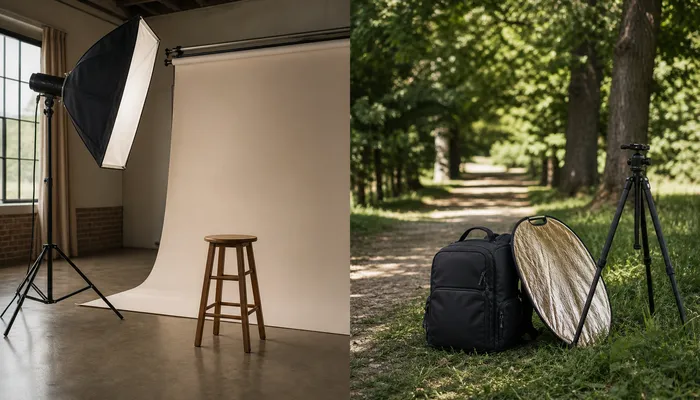
Most families do not start by choosing a room or a park. They start with a picture in their head: a clean portrait above the sofa, a newborn’s first weeks documented calmly, a celebration recorded while it is actually happening. The question of where comes second, and it is usually the one that stalls the booking. In practice, choosing between a studio session vs on-location photography comes down to what you want the final images to show, not to which option sounds more professional.
Video Studio Jimenez works both ways. Studio work takes place at the official Chicago studio, where light, backdrop and posing are controlled from the first frame. On-location coverage happens where the event or the family moment takes place, with the team adapting to the schedule, the venue and the available light. Both formats are planned in advance rather than improvised on the day, and both draw on the same experience with weddings, quinceañeras, maternity sessions, newborn photography, portraits, passport photos and photo restoration.
What Changes When the Session Happens in a Studio
Inside a studio, the photographer controls the variables that usually cause problems outdoors: light direction, colour temperature, the background behind you, and the distance between you and the camera. That control is what makes a studio portrait session predictable. Frames match each other because the light does not shift between shots, so a sequence of family portraits looks like one set instead of five different days.
Control also helps when the subject cannot hold still or follow directions for long. Newborn sessions, maternity sessions and family portraits with small children benefit from a room where the temperature, the space and the pace can be adjusted. Passport photos are a different case again: correct framing, a plain background and even lighting are practical requirements, and a studio handles those quickly without guesswork. Photo restoration clients also tend to start in the studio, where an old print can be reviewed in person before anything is done to it.
What to Confirm Before You Arrive
A studio visit is easier to prepare when a few details are settled beforehand. Before confirming a date, it helps to share:
- The type of session: portrait, family, newborn, maternity, passport or restoration.
- How many people will be photographed and whether children will join.
- Whether you plan to change outfits or include more than one look.
- Any reference images that show the style you have in mind.
- Your preferred time window inside the studio’s regular hours.
Arriving with those details already discussed shortens the setup and leaves more time for actual photographs. If you are unsure what to bring, this guide on what to prepare before a studio photo shoot covers the practical side in more detail. It is also worth knowing how photographic studios differ from one another, because not every studio is set up for the same kind of work.
What Changes When the Team Travels to Your Location
On-location coverage reverses the trade. Instead of bringing the people to a controlled room, the team brings the equipment to the event. Weddings, quinceañeras, milestone birthdays and celebrations usually belong in this category, because the value of those images is the moment itself: the ceremony as it happened, the family gathered at the same table, the dance floor at the right hour. Recreating that in a studio is not possible, and that is precisely why the format exists.
What changes most is the amount of planning. The photographer is working with the light that exists, the space the venue allows and the timeline the hosts have set. Posing guidance becomes quicker and more discreet, because guests are there to celebrate and not to stand still. Coverage is built around the order of the day rather than around a lighting setup, so the schedule matters as much as the equipment list.
The Details That Decide How Event Coverage Runs
Before confirming on-location work, these are the details that shape how the day actually runs:
- Event date, start time and the moments that matter most to you.
- Address and access details, including where the team can park and set up.
- Venue rules about photography, flash, or moving between rooms.
- A rough timeline: ceremony, portraits, dinner, speeches, dancing.
- The key people you want photographed, including grandparents, siblings or godparents.
Venue rules in particular are easy to overlook. Many spaces have their own requirements about where a photographer can stand or what equipment is allowed during a ceremony, so it is worth checking in writing beforehand — you can see what to confirm with a venue before photo coverage as a starting checklist.
How Families Usually Choose Between the Two
The decision usually follows the desired result rather than a preference for one format. If the images you are imagining are clean, evenly lit and framed the same way throughout — a portrait for the wall, a headshot, a newborn set, a family photo where nobody is squinting — the studio is normally the starting point. You get consistency, and you get a space where children can be settled without an audience.
If what matters is the event as it unfolds, on-location coverage is the honest choice. A staged version of a wedding ceremony or a quinceañera waltz does not carry the same weight as the real one. Families who choose this route are usually protecting the memory more than the composition, and the photographs are built around the day’s natural rhythm.
Mixed Formats: Studio Portraits Plus Event Coverage
Many clients do not have to choose at all. A common combination is a studio session for formal portraits ahead of a wedding, quinceañera or graduation, and on-location coverage on the event date itself. The formal images stay controlled and consistent, while the event coverage captures everything that cannot be repeated. This also helps when the venue is dark, crowded or weather-dependent, because the portraits are already done and the coverage can focus on what is happening in front of the camera.
Both formats are planned with the same preparation standard, which is what the studio’s Captured for Life Guarantee™ is meant to reflect. That does not mean every frame is identical to a sample image, but it does mean the session is discussed, structured and edited with care.
A Note for Families in Lake View and Nearby North Side Neighborhoods
Lake View is a Chicago community area on the city’s North Side, bordered on the east by the shore of Lake Michigan, and it is one of the areas the studio regularly serves. Families around Wrigleyville, Boystown, the Southport Corridor and the surrounding blocks tend to book in both directions: studio time when the priority is a clean portrait with dependable light, and on-location coverage when the celebration happens in a venue, a home, a restaurant or along the lakefront. You can also check the community area boundaries if you are confirming whether your address falls inside Lake View.
One practical point matters here. The official studio is located in Chicago, not inside Lake View, so on-location sessions in the neighborhood are planned as coverage: travel, setup time and the session window are confirmed before the date instead of being assumed on arrival. That is normal for both studio and event work, and it keeps expectations clear on both sides. If you want to compare studio and on-location sessions with the Chicago studio, that page lays out the available options, the service area and how each format is booked.
Questions to Ask Before You Book Either Format
Whichever direction you are leaning, a short list of questions removes most of the uncertainty before money changes hands:
- What exactly does the session include, and how long is the working time?
- What is delivered after editing, and in what form?
- Does the format fit the number of people involved?
- For on-location work, who handles access, timing and venue permissions?
- For studio work, what should we bring and how early should we arrive?
- What happens if the weather, a venue or a small child does not cooperate?
Before a quote can be meaningful, the studio needs a few specifics: the type of session, the date you are aiming for, the location if it is on-location work, and the number of people who will be photographed. With those in hand, the practical differences between a studio session and travel coverage usually become obvious, and the conversation moves from comparing formats to booking one.
Next Step: Share the Session Type, Date and Location
If you already know what you want photographed, the fastest way forward is to send the details. Tell us whether you are picturing a studio portrait session, on-location coverage for an event, or a combination of both, and include the date, the location if applicable and how many people will be in the photographs. You can reach the team through the contact page to confirm availability and talk through the format that fits your plans.